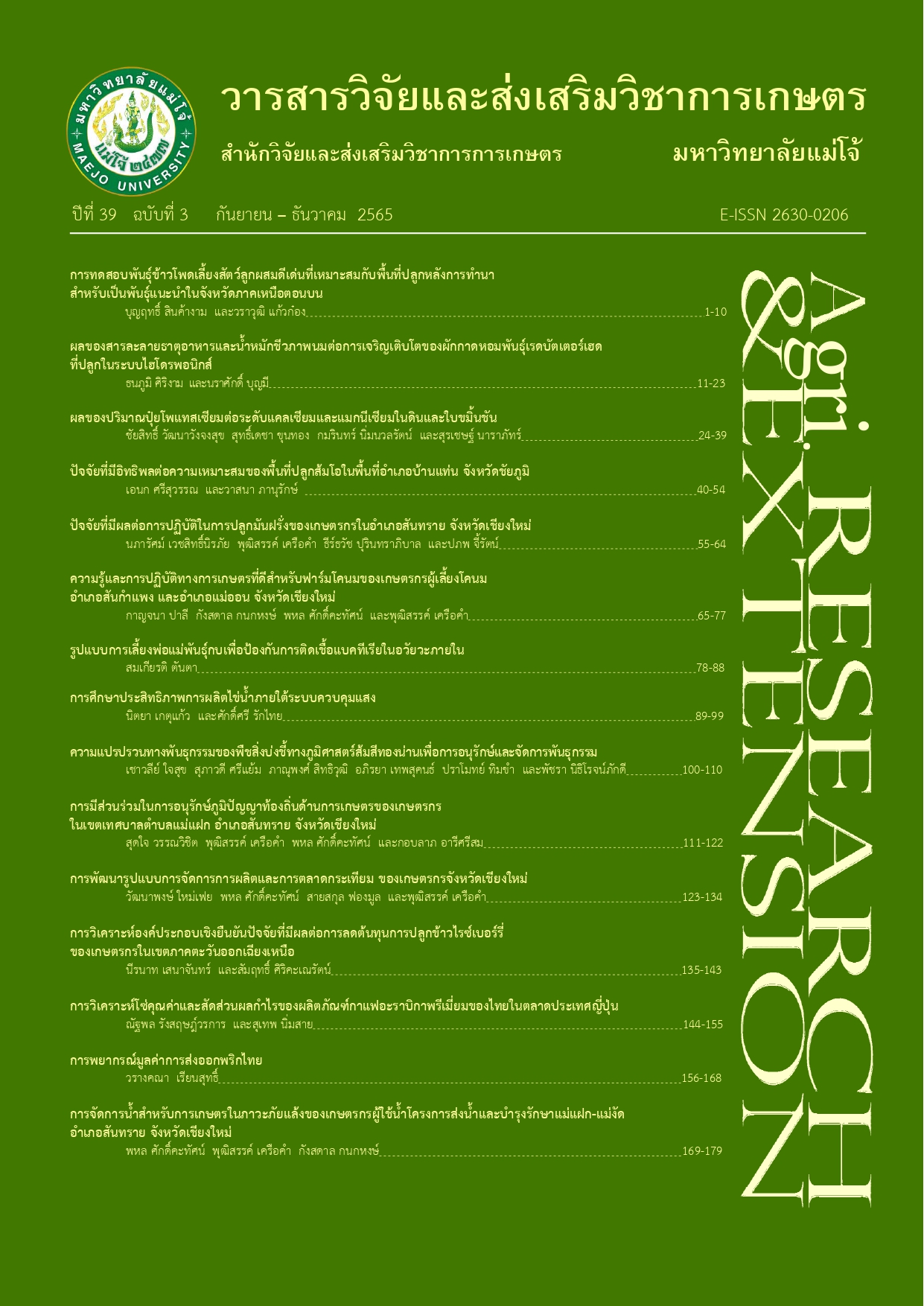
Water Management for Agriculture during Drought of Farmers Using Water under Mae Faek-Mae Ngat Operation and Maintenance Project, Sansai District, Chiang Mai
Keywords:
irrigation water users, water management in drought condition, Mae Faek-Mae Ngat Operation and Maintenance ProjectAbstract
This study was conducted to investigate: 1) water management strategies employed by during drought; 2) factors affecting which aspect of water management for agriculture during drought; and 3) guidelines for the management of water during drought. A set of questionnaires was used for data collection administered with a sample group of 305 farmers using water of Mae Faek-Mae Ngat operation and maintenance project. Obtained data were analyzed by using descriptive statistics and multiple regression. Result of the study revealed that, as a whole, the responds had moderate level of water management for agriculture ( =3.17). Based on its details, the reduction of an amount of water used for agriculture was found to have the highest average mean score. This was followed by management of water resource conservation; change of culverted plant varieties; cultivation area management; and finding new water sources. The following had an effect on water management for agriculture during drought with a statistical significance level (Sig.<0.05): farming area; information perception about water management; and irrigational personnel contact. The following were guidelines for water management for agriculture during drought: 1) expansion of water supply area; 2) repairing irrigation canals before the growing season; 3) making a survey for the construction of new water storage sources; 4) support on reforestation in water shade areas; 5) setting a policy on measure to prevent forest encroachment or deforestation; 6) support on knowledge transfer about appropriate use of water for agricultural during drought; and 7) providing an opportunity for farmers and concerned private agencies to participate in the determination of water management direction and readiness preparation together with concerned public agencies.
References
Chompooming, P., J. Nimpanich, S. Suksamran and W. Wamanond. 2015. Networking Governance in water resources management: case study of Yom river basin region. The Golden Teak: Humanity and Social Science 21(3): 145-159. [in Thai].
Jitae, S. 2019. Participation of farmers, activities in water resource management in Li watershed, Lamphun province. King Mongkut's Agricultural Journal 37(3): 519-526. [in Thai].
Kessung, P. 2016. Action Research. Bangkok: Chulalongkorn University Printing House. 301 p.
Klinsreesuk, R., S. Srisai and J. Vibhatakalasa. 2017. Effective water management with participation of the people in The Regional Irrigation Office 11 Royal Irrigation Department. VRU Research and Development Journal Science and Technology 12(3): 167-176. [in Thai]
Prasitratsin, S. 2003. Social Research Methodology. Bangkok: National Institute of Development Administration. 308 p. [in Thai]
Royal Irrigation Department. 2011a. Irrigation Water Management Group. 2nd. Bangkok: Amornprint. 31 p.
Royal Irrigation Department. 2011b. Water Management and Irrigation User Organization Management. 2nd. Bangkok: Amornprint. 211 p.
Saipatthana, U. and C. Piyapimonsit. 2004. Collinearity. Parichart Journal 17(1): 55-62. [in Thai].
Thipparatanadetch, S. 2012. Participatory Development and Water Users Organization Empowerment in Mae Faek-Mae Ngat Operation and Maintenance Project, Sansai District, Chiang Mai. Doctoral Dissertation. Maejo University. 283 p.
Vanichbuncha, K. 2018. Statistics for Research. 14th. Bangkok: Chulalongkorn University Printing House. 320 p.
Yamane, T. 1973. Statistics: An Introductory Analysis. 3rd. New York: Harper and Row Publication. 1130 p.
Simsuay, C. 2013. Evolution and changing pattern of water resources management for agriculture in Mae-Khan watershed Chiangmai province. Romphruek Journal 31(3): 85-114.
Hydro-Informatics Institute. 2016. Record of drought in 2015/2016. [Online]. Available https://www.thaiwater.net/current/2016/drought59/drought59.html. (3 September 2016).
Downloads
Published
How to Cite
Issue
Section
License
Copyright (c) 2022 Journal of Agricultural Research and Extension

This work is licensed under a Creative Commons Attribution-NonCommercial-NoDerivatives 4.0 International License.
This article is published under a Creative Commons Attribution-NonCommercial-NoDerivatives 4.0 International License (CC BY-NC-ND 4.0), which allows others to share the article with proper attribution to the authors and prohibits commercial use or modification. For any other reuse or republication, permission from the journal and the authors is required.


