
Water Requirement of Arabica Coffee under Different Shade Conditions during the Dry Season
DOI:
https://doi.org/10.14456/jare-mju.2026.23Keywords:
coffee, arabica, water requirement, evapotranspiration, sap flowAbstract
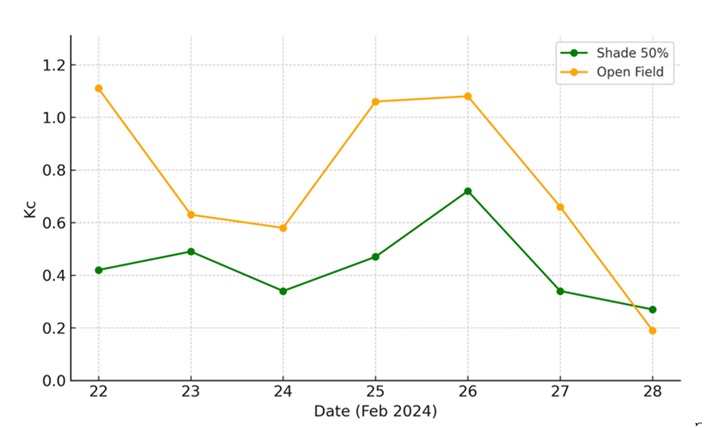
This study investigated the water use of Arabica coffee (Coffea arabica L.) under different shading environments during the dry season. The experiment was conducted from February 22 to 28, 2024, at Maejo University. Four 3-year-old Arabica coffee trees were each planted in a 30-liter pot and assigned to one of two treatments: under a 50% shade net or in an open field (full sunlight), with two plants per treatment. All trees were at the floral bud stage, which is known to respond strongly to irrigation. Sap flow sensors were installed to measure actual plant water use (ETc), and weather data were collected from an automatic weather station to calculate reference evapotranspiration (ETo) and the daily crop coefficient (Kc). The objectives were: 1) to evaluate the water use of arabica coffee under different shading conditions using the sap flow technique; 2) to determine crop coefficients (Kc) for accurate irrigation scheduling during the dry season; and 3) to assess the relationships between vapor pressure deficit (VPD) with both ETo and ETc. Results showed that open-field plants had higher average ETc (2.15 L plant-1 day-1) and Kc (1.39) compared to shaded plants (ETc = 1.06 L plant-1 day-1, Kc = 0.61). The coefficient of determination (R²) between VPD and ETo was 0.934, while the R² between VPD and ETc was 0.526, reflecting the plant’s physiological regulation of transpiration under varying microclimate conditions. These findings provide a basis for more precise irrigation planning in coffee cultivation, especially during flowering induction in dry periods.
References
Allen, R.G., L.S. Pereira, D. Raes and M. Smith. 1998. Crop evapotranspiration: guidelines for computing crop water requirements (FAO Irrigation and Drainage Paper No. 56) FAO. Retrieved from https://www.fao.org/3/x0490e/x0490e00.htm
Carr, M.K.V. 2001. The water relations and irrigation requirements of coffee. Experimental Agriculture 37 (1): 1–36. https://doi.org/10.1017/S0014479701001017
DaMatta, F.M., C.P. Ronchi, M. Maestri and R.S. Barros 2007. Ecophysiology of coffee growth and production. Brazilian Journal of Plant Physiology 19(4): 485–510. https://doi.org/10.1590/S1677-04202007000400014
Department of Agricultural Extension. 2023. Arabica Coffee Production Manual Bangkok: Ministry of Agriculture and Cooperatives. 31 p. [in Thai].
Kunjet, S., S. Yamuangmorn and P. Theerakulpisut. 2020. Sap flow and stomatal conductance of durian trees under different irrigation regimes. Kasetsart Journal - Natural Science 54(5): 647–656.
Nation Thailand. 2024. Thailand’s coffee import statistics rise 12%. Retrieved from https://www.nationthailand.com
Office of Agricultural Economics. 2023. Agricultural production statistics: coffee. Ministry of Agriculture and Cooperatives. Retrieved from http://www.oae.go.th/
Thai Meteorological Department. 2023. Monthly climate summary. Retrieved from http://www.tmd.go.th
Van Asten, P.J.A., L.W.I. Wairegi, D. Mukasa and N.O. Uringi. 2011. Agronomic and economic benefits of coffee–banana intercropping in Uganda’s smallholder farming systems. Agricultural Systems 104 (4): 326–334. https://doi.org/10.1016/j.agsy.2010.12.004
Wintgens, J.N. 2012. The Coffee Plant. pp. 1–24 In Wintgens, J.N. (ed.). Coffee: Growing, Processing, Sustainable Production: A Guidebook for Growers, Processors, Traders, and Researchers. Weinheim: Wiley-VCH.
Downloads
Published
How to Cite
Issue
Section
License
Copyright (c) 2026 Journal of Agricultural Research and Extension

This work is licensed under a Creative Commons Attribution-NonCommercial-NoDerivatives 4.0 International License.
This article is published under a Creative Commons Attribution-NonCommercial-NoDerivatives 4.0 International License (CC BY-NC-ND 4.0), which allows others to share the article with proper attribution to the authors and prohibits commercial use or modification. For any other reuse or republication, permission from the journal and the authors is required.


