Effects of Day Length and Temperature on Growth and Development of Vanda ‘Pakchong Blue’
DOI:
https://doi.org/10.14456/jare-mju.2026.21Keywords:
Vanda orchid, shading, low temperature, offseason, photoperiodAbstract
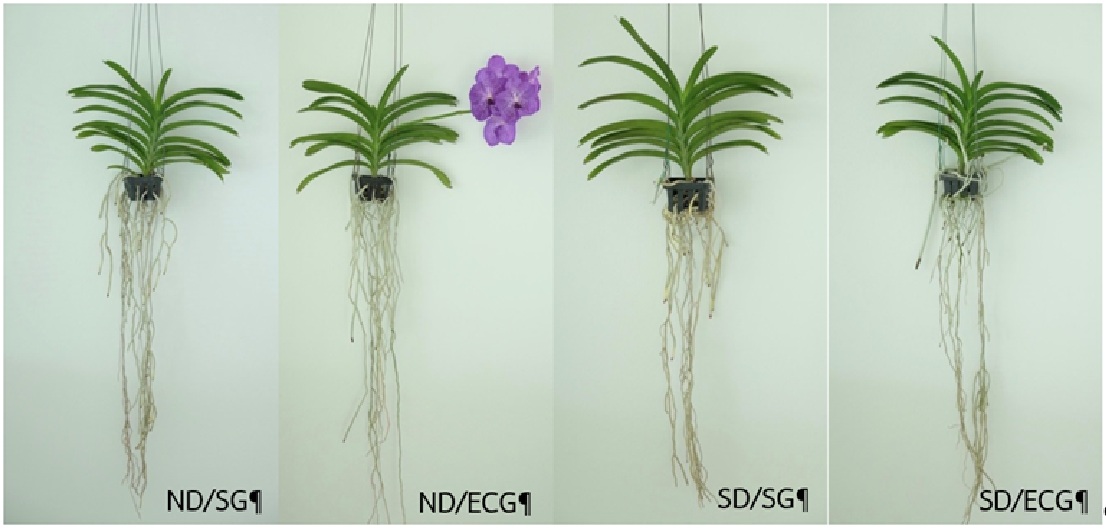
The demand for orchids, both domestically and internationally, is consistently high throughout the year. However, the production of Vanda orchids, particularly the hybrid Vanda ‘Pakchong Blue’, is still challenging in the summer season when the market demand is high. This research aimed to study the effects of day length and temperature on vegetative growth and flowering regulation during the summer season. The plants were subjected to two different factors: two levels of day length conditions, day length about 12 hours and short-day length of 7 hours (Factor 1); and two levels of cultivation temperature, 30±2°C in a 50% shading greenhouse (Factor 2), and 25±2 °C in an evaporative cooling greenhouse (4 treatments: ND+SG, ND+ECG, SD+SG, SD+ECG). The plants received the same light intensity, averaging 350 µmol m-² s-1. The experimental results showed that different day length and temperature conditions had no significant effects on vegetative growth parameters, including plant height, leaf length, and number of leaves throughout the experiment. However, the experimental treatments resulted in statistically significant differences in flowering response. Providing the Vanda ‘Pakchong Blue’ with short-day conditions delayed the flowering compared with a 12-hour day length Additionally, growing the orchids in an evaporative cooling greenhouse significantly improved flower quality and flowering efficiency, with a higher blooming percentage and a longer flower spike lifespan compared with those grown in the 50% shading greenhouse.
References
Arditti, J. 1992. Fundamentals of Orchid Biology. New York: John Wiley & Sons. 691 p.
Banyai, K., S. Ruamrungsri and N. Potapohn. 2010. Effects of photoperiod and GA3 on plant nutrients and off-season flowering of Rhynchostylis gigantea (Lindl.) Ridl. The Horticulture Journal 26(1): 43–50. [in Thai]
Blanchard, M.G. and E.S. Runkle. 2006. Temperature during the day, but not during the night, controls flowering of Phalaenopsis orchids. Journal of Experimental Botany 57: 4043–4049.
Department of International Trade Promotion. 2024. Herb and spice market in Japan. Retrieved from https://www. ditp.go.th/post/169480 [in Thai]
Grove, D.L. 1995. Vandas and Ascocendas and Their Combinations with Other Genera. Portland: Timber Press, Inc. 241 p.
Jearwattana, M., D. Naphrom and N. Potapohn. 2014. Changes of gibberellin-like substances content during flowering of Rhynchostylis gigantea (Lindl.) Ridl. The Horticulture Journal 30(3): 263–269. [in Thai]
Lopez, R.G. and E.S. Runkle. 2005. Environmental physiology of growth and flowering of orchids. HortScience 40(7): 1969–1973.
Ruamrungsri, S., C. Inkham, T. Sirisawad, P. Kongkeaw, P. Hongpakdee and K. Panjama. 2024. Flowering behavior and temperature affected on growth and flowering of blue Vanda hybrid. Social Science Research Network 30: 1–32.
Ruamrungsri, S., T. Sirisawad, K. Panjama, N. Potapohn and C. Inkham. 2021. Effects of short day cycles on flowering time and nutritional status of Vanda. The Horticulture Journal 90(1): 108–113.
Sirisawad, T. and S. Ruamrungsri. 2018. Annual flower bud development of Vanda Manuvadee. Journal of Agriculture and Crops 34(3): 341–351. [in Thai]
Sirisawad, T., N. Potapohn and S. Ruamrungsri. 2015. Effects of evaporative cooling greenhouse growing on flowering of Vanda. Acta Horticulturae 1078: 107–112.
Downloads
Published
How to Cite
Issue
Section
License
Copyright (c) 2026 Journal of Agricultural Research and Extension

This work is licensed under a Creative Commons Attribution-NonCommercial-NoDerivatives 4.0 International License.
This article is published under a Creative Commons Attribution-NonCommercial-NoDerivatives 4.0 International License (CC BY-NC-ND 4.0), which allows others to share the article with proper attribution to the authors and prohibits commercial use or modification. For any other reuse or republication, permission from the journal and the authors is required.


