Effect of Plant Spacing on Growth, Yield, and Cannabidiol Content of Hemp Cultivars EHFGP#1, EHFGP#3, and EHFGP#8 under Greenhouse Condition
DOI:
https://doi.org/10.14456/jare-mju.2026.24Keywords:
plant spacing, hemp, cannabidiol, planting factors, varietyAbstract
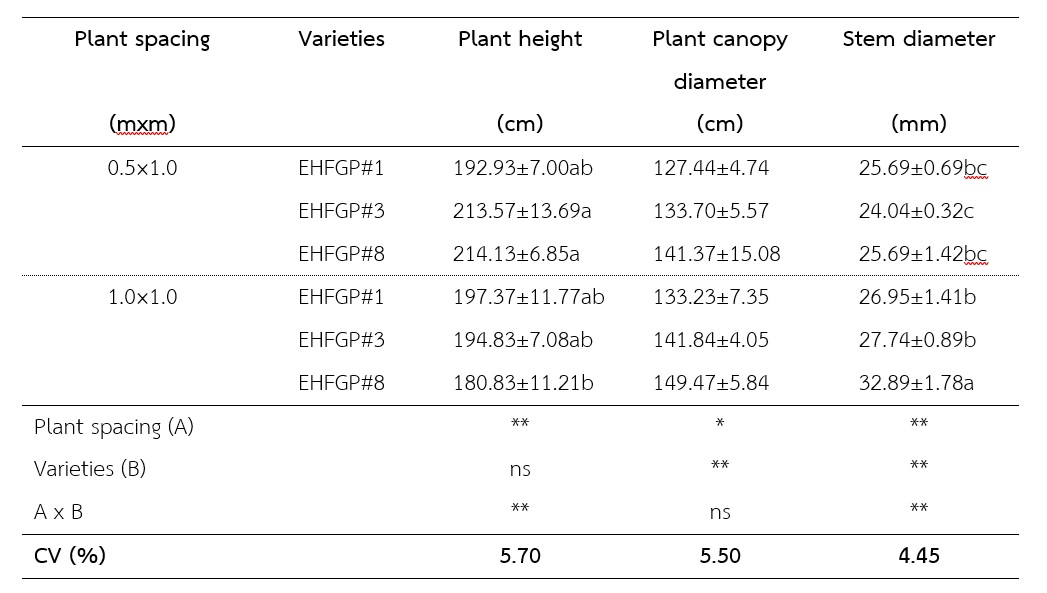
This study aimed to investigate the effect of plant spacing on growth, yield, and cannabidiol content of hemp cultivars EHFGP#1, EHFGP#3, and EHFGP#8 under greenhouse conditions. The experiment followed a 2×3 factorial arrangement in a Randomized Complete Block Design (RCBD), with factor A being two plant spacings (0.5×1.0 m and 1.0×1.0 m), and factor B being three hemp varieties (EHFGP#1, EHFGP#3, and EHFGP#8). This study was conducted at the Hemp Research and Development Center, Maejo University, Chiang Mai, Thailand. The results revealed that cultivar, plant spacing, and their interaction significantly (p≤0.01) affected several morphological and yield characteristics. For growth traits, cultivars EHFGP#3 and EHFGP#8 grown at the 0.5×1.0 m spacing exhibited the greatest plant height, averaging 213.57 and 214.13 cm, respectively, whereas cultivar EHFGP#8 grown at the 1.0x1.0 m spacing had the lowest height. Plant canopy diameter varied considerably among cultivars, with EHFGP#8 showing the widest canopy at both spacings. The largest stem diameter was recorded for EHFGP#8 at the 1.0x1.0 m spacing, indicating stronger stem development under wider spacing. Plants grown at 1.0x1.0 m also had significantly greater numbers of nodes (4.00–4.40 per plant) and numbers of branches (7.20–8.00 per plant) than those at 0.5x1.0 m. A significant interaction between plant spacing and cultivar was observed for inflorescence size, with EHFGP#1 at 0.5x1.0 m and EHFGP#3 at 1.0×1.0 m producing the widest inflorescences (36.37 and 36.29 mm, respectively). For yield attributes, the 1.0x1.0 m spacing resulted in higher fresh and dry inflorescence yields per plant (0.90–1.08 kg and 0.21–0.26 kg, respectively) than the 0.5x1.0 m spacing (0.52–0.78 kg fresh weight per plant and 0.12–0.18 kg dry weight per plant). However, the total dry inflorescence yield per greenhouse (160 m²) did not differ significantly between treatments, ranging from 16.24 to 26.93 kg, indicating that plant spacing did not affect total yield per growing area. Regarding cannabidiol content, cultivar, plant spacing, and their interaction had a highly significant effect on CBD concentration. The highest CBD content (14.32%) was found in cultivar EHFGP#1 grown at 1.0×1.0 m spacing, followed by EHFGP#3 (12.63%) and EHFGP#8 (10.58%), while narrower spacing (0.5×1.0 m) resulted in lower CBD contents. Therefore, a plant spacing of 1.0x1.0 m under greenhouse cultivation was the most suitable for optimizing flower production and enhancing CBD accumulation, particularly for cultivar EHFGP#1, which demonstrated the highest potential for high-value compound production. This study provides essential insights for developing production strategies for high-quality hemp cultivation to support the emerging hemp industry.
References
Amaducci, S., A. Zatta, F. Pelatti and G. Venturi. 2008. Influence of agronomic factors on yield and quality of hemp (Cannabis sativa L.) fibre and implication for an innovative production system. ScienceDirect 107: 161–169.
Brown, A., M. Soutor and S. Ellison. 2025. Impact of plant density on stem diameter, plant height, and branching in hemp (Cannabis sativa L.). Agrosystems, Geosciences & Environment 8: e70126.
Danziger, N. and N. Bernstein. 2022. Too dense or not too dense: higher planting density reduces cannabinoid uniformity but increases yield/area in drug-type medical cannabis. Frontiers in Plant Science 13: 713481.
de Meijer, E.P.M., H.J. van der Kamp and F.A. van Eeuwijk. 1992. Characterisation of Cannabis accessions with regard to cannabinoid content in relation to other plant characters. Euphytica 62: 187–200.
Department of Agriculture (Thailand). 2022. Notification of the Department of Agriculture Re: Public Announcement of the Application for the Issuance of a Certificate of Registered Plant Variety Pursuant to the Plant Varieties Act, B.E. 2518 (1975). Bangkok: Department of Agriculture, Ministry of Agriculture and Cooperatives. 57 p. [in Thai]
Grassa, C.J., G.D. Weiblen, J.P. Wenger, C. Dabney, S.G. Poplawski, S.T. Motley, T.P. Michael and C.J. Schwartz. 2021. A new Cannabis genome assembly associates elevated cannabidiol (CBD) with hemp introgressed into marijuana. New Phytologist 230: 1665–1679.
Linder, E.R., S. Young, X. Li, S. Henriquez Inoa and D.H. Suchoff. 2022. The effect of transplant date and plant spacing on biomass production for floral hemp (Cannabis sativa L.). Agronomy 12: 1856.
Lisson, S.N., N.J. Mendham and P.S. Carberry. 2000. Development of a hemp (Cannabis sativa L.) simulation model 3: The effect of plant density on leaf appearance, expansion and senescence. Australian Journal of Experimental Agriculture 40: 419–423.
McLennon, E., B. Charlton and K. Carson. 2024. Comparison of Stem and Fiber Yield: Industrial Hemp Varietal Trial. 8 p. In Research Report. Oregon: Oregon State University Extension Service.
Ministry of Public Health (Thailand). 2025. Notification of the Ministry of Public Health on Controlled Herbal Plant (Cannabis), B.E. 2568. Retrieved from https://www.dtam.moph.go.th/sub-law/42864/ [in Thai]
Panday, D., B.S. Acharya, M. Dhakal, T. Caton, C. Lapham, A. Smith and A. Ghalehgolabbehbahani. 2025 Industrial hemp yield and chemical composition as influenced by row spacing, fertilization, and environmental conditions. Agrosystems, Geosciences and Environment 8: e70093.
Salentijn, E.M.J., Q. Zhang, S. Amaducci, M. Yang and L.M. Trindade. 2014. New developments in fiber hemp (Cannabis sativa L.) breeding. Industrial Crops and Products 68(1): 32–41.
Schober, T., A. Präger, J. Hartung and S. Graeff-Hönninger. 2024. The effects of plant density and duration of vegetative growth phase on agronomic traits of medicinal cannabis (Cannabis sativa L.): a regression analysis. PLOS ONE 19(12): 1–28.
Tang, K., P.C. Struik, X. Yin, C. Thouminot, M. Bjelková, V. Stramkale and S. Amaducci. 2017. Comparing hemp (Cannabis sativa L.) cultivars for dual-purpose production under contrasting environment. Industrial Crops and Products 87: 33–44.
Vanhove, W., P.V. Dammea and N. Meert. 2011. Factors determining yield and quality of illicit indoor cannabis (Cannabis spp.) production. Forensic Science International 212: 158–163.
Yazici, L. 2022. Optimizing plant density for fiber and seed production in industrial hemp (Cannabis sativa L.). Journal of King Saud University – Science 35: 102419.
Downloads
Published
How to Cite
Issue
Section
License
Copyright (c) 2026 Journal of Agricultural Research and Extension

This work is licensed under a Creative Commons Attribution-NonCommercial-NoDerivatives 4.0 International License.
This article is published under a Creative Commons Attribution-NonCommercial-NoDerivatives 4.0 International License (CC BY-NC-ND 4.0), which allows others to share the article with proper attribution to the authors and prohibits commercial use or modification. For any other reuse or republication, permission from the journal and the authors is required.


