Land Tenure Security and Sustainable Land Use Case Study on the Policy of Land Allocation for Communities by the National Land Policy Committee (NLPC) in the National Reserved Forest Area
DOI:
https://doi.org/10.14456/jare-mju.2026.37Keywords:
land allocation for communities, land tenure stability, National Land Policy Committee (NLPC)Abstract
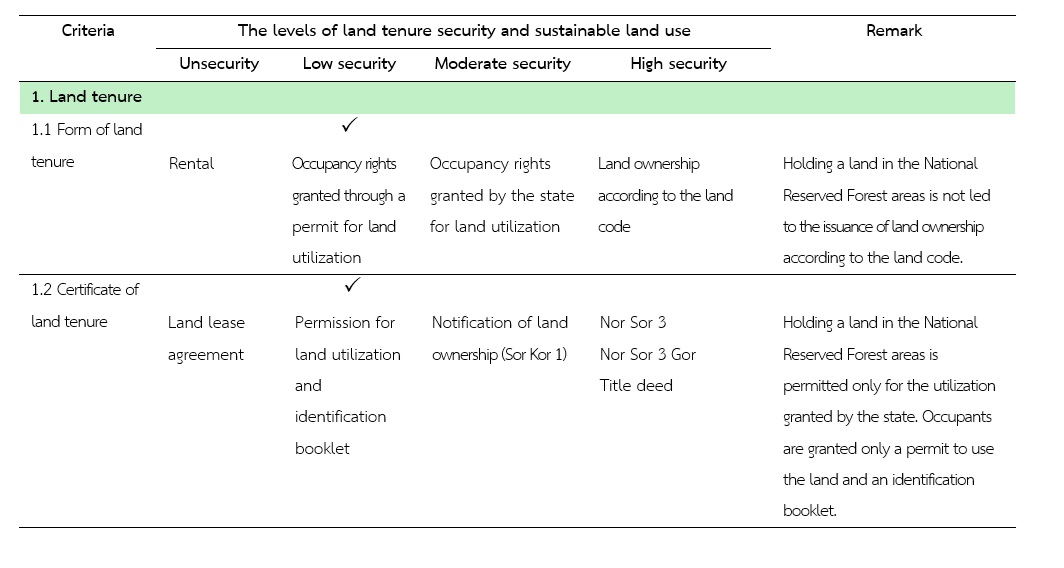
This research is a mixed-methods research study that collects data through documentary research, in-depth interviews with ten key informants, and surveys using structured interviews with a sample group of 343 individuals. Qualitative data were analyzed using content analysis, while quantitative data were processed using statistical software and interpreted through descriptive statistics. The study found that past government policies allocated land to individuals for private ownership. However, once the land was allocated, a significant number of recipients engaged in buying and selling, there by leading to further encroachments in search of new agricultural land. As a response, the government revised its land allocation policy, particularly in national forest reserves, to implement a community-based land allocation model by the National Land Policy Committee (NLPC) in the form of joint ownership. Reguarding perception of this system most respondents in the sample group were of the opinion that the joint ownership system provides relatively low security of tenure. This is because the right granted, are primarily rights of occupation certified for utilization, along with a personal booklet allowing land use for productive purposes. Nevertheless, there remains a lack of clarity regarding the long-term development framework. This uncertainly may affect ownership security, as it could lead to inheritance by heirs, together with the enforcement of clear regulations prohibiting sale or transfer to other parties. At the same time, these regulations also define the conditions for land use, there by enabling communities to plan for the sustainable development of the area in the future.
References
Jameekorn, S. 1983. Analytical Statistics for Social Science Research. Bangkok: Kasetsart University. 150 p. [in Thai]
Kraiyurawong, S., B. Chairat, R. Chaisawat, P. Pholpinyo, K. Payaksak and P. Withantirawat. 2006. Disputes and Conflicts on Land Problems in Thailand. Bangkok: Thailand Research Fund (TRF). 445 p. [in Thai]
Kuthin, U. 2021. Sustainable Land Use and Natural Resource Management. Bangkok: Faculty of Forestry, Kasetsart University. 336 p. [in Thai]
Land Bank Management Institute (Public Organization). 2023. Annual Report 2023. Bangkok: Office of the Prime Minister. 144 p. [in Thai]
Office of Natural Resources and Environmental Policy and Planning. 2018. The Project of Driving Potential Promotion in National Land and Soil Resource Management Plan (B.E. 2560-2564). Bangkok: Ministry of Natural Resources and Environment. 197 p. [in Thai]
Office of the National Land Policy Board. 2023. Land Allocation Project for Communities under the National Land Policy Committee (NLPC). 5th Ed. Bangkok: Office of the National Land Policy Board. 213 p. [in Thai]
Rattanawaraha, A. 2015. The Land Economy of Thailand: A State of Knowledge Series. Bangkok: National Research Council of Thailand. 318 p. [in Thai]
Royal Forest Department. 2015. Basic Data of the National Forest Reserve Management Center No. 55-75, Forest Resource Management Office No. 3 (Lampang). Bangkok: Ministry of Natural Resources and Environment. 74 p. [in Thai]
Rungruangtantisuk, T. 2020. Forest conservation and the Thai military's new role after warfare against the Thai Communist Party (CPT): a case of Land Allocation for Poor in Degraded Forest Land (Kor Jor Gor) Journal of History 45: 117–132. [in Thai]
Samranjit, P. 2013. Tangible Imaginary Community Title Deed. Bangkok: Local Action Group without Borders. 335 p. [in Thai]
United Nations Statistics Division Development Data and Outreach Branch. 2019. SDGs indicators metadata repository. Retrieved from https://unstats.un.org/sdgs/metadata/
United Nations. 2024. The world population prospects 2024. Retrieved from https://www.nso.go.th/public/e-book/Statistical-Yearbook/SYB-2024/55/
Yamane, T. 1973. Statistics: An Introductory Analysis. New York: Harper & Row. 1130 p.
Downloads
Published
How to Cite
Issue
Section
License
Copyright (c) 2026 Journal of Agricultural Research and Extension

This work is licensed under a Creative Commons Attribution-NonCommercial-NoDerivatives 4.0 International License.
This article is published under a Creative Commons Attribution-NonCommercial-NoDerivatives 4.0 International License (CC BY-NC-ND 4.0), which allows others to share the article with proper attribution to the authors and prohibits commercial use or modification. For any other reuse or republication, permission from the journal and the authors is required.