Chemical Composition of Durian (Durio zibethinus ) cv. Long Lab Lae Grown in Thailand
DOI:
https://doi.org/10.14456/jare-mju.2026.45Keywords:
durian, geographical indication, Long Lab Lae, nutritional profile, proximate composition, Uttaradit provinceAbstract
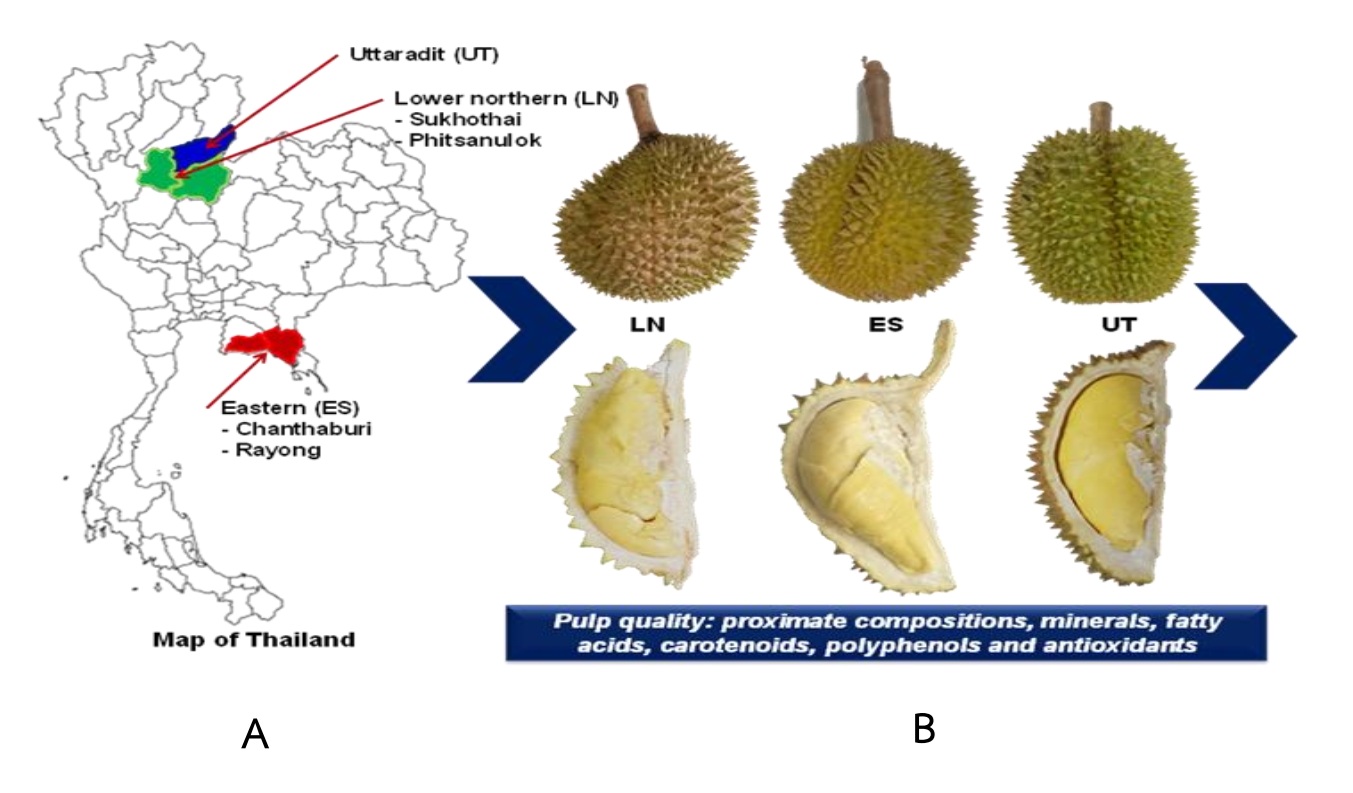
This study investigated the chemical composition and nutritional characteristics of Long Lab Lae durian (Durio zibethinus Murr.), an economically important Thai fruit cultivar that is officially recognized as a Geographical Indication (GI) product. Fruits were collected from three growing regions, namely Uttaradit Province (UT), Lower Northern Thailand (LN), and Eastern Thailand (ES), and analyzed for proximate composition, mineral content, fatty acid profile, carotenoids, total phenolic content, and antioxidant activity. The growing location significantly influenced the chemical composition and nutritional characteristics of Long Lab Lae durian. Fruits from UT and LN contained higher carbohydrate and fat but lower moisture levels than those from ES. Sucrose was the predominant sugar in all samples, with the highest concentration observed in LN fruit 22.07 g/100 g fresh weight (FW). Potassium was the most abundant mineral, followed by phosphorus, magnesium, and calcium. Monounsaturated fatty acids constituted the major lipid fraction, with elevated oleic acid levels detected in fruits from UT and LN (2.37 and 2.33 g/100 g FW, respectively). In addition, UT fruit exhibited the highest β-carotene content (86.29 µg/100 g FW). In contrast, total phenolic content and antioxidant activity did not differ significantly among growing regions. These findings demonstrate that geographical origin plays an important role in determining the chemical and nutritional attributes of Long Lab Lae durian. The distinctive GI characteristics of Uttaradit Long Lab Lae durian, including its dry texture, fine flesh, and rich sweet-creamy flavor, are closely linked to variations in the physicochemical properties of the fruit associated with the growing environment. This study provides scientific evidence supporting the unique quality attributes and geographical identity of Long Lab Lae durian and thereby reinforcing its recognition as a geographical indication product.
References
AOAC. 2005. Official Methods of Analysis. 18th ed. Washington DC: Association of Official Analytical Chemists. 1200 p.
AOAC. 2016. Official Methods of Analysis, 20th ed. Gaithersburg, MD: Association of Official Analytical Chemists. 1400 p.
Arancibia-Avila, P., F. Toledo, Y. Park, S. Jung, S. Kang, B.G. Heo, S. Lee, M. Sajewicz, T. Kowalska and S. Gorinstein. 2008. Antioxidant properties of durian fruit as influenced by ripening. LWT-Food Science and Technology 41: 2118–2125. https://doi.org/10.1016/j.lwt.2007.12.001.
Arsa, S., A. Wipatanawin, R. Suwapanich, O. Makkerdchoo, N. Chatsuwan, P. Kaewthong, P. Pinsirodom, R. Taprap, R. Haruenkit, S. Poovarodom, M. Lubinska-Szczygeł, E. Katrich and S. Gorinstein. 2021. Properties of different varieties of durian. Applied Sciences 11: 5653. https://doi.org/10.3390/app11125653
Aschariyaphotha, W., C. Wongs-Aree, K. Bodhipadma and S. Noichinda. 2021. Fruit volatile fingerprints characterized among four commercial cultivars of Thai durian (Durio zibethinus). Journal of Food Quality 2021: 1–10. https://doi.org/10.1155/2021/1383927
Aziz, N.A.A. and A.M.M. Jalil. 2019. Bioactive compounds, nutritional value, and potential health benefits of indigenous durian (Durio zibethinus Murr.): a review. Foods 8(3): 1–18.
Benzie, I.F.F. and J.J. Strain. 1996. The ferric reducing ability of plasma (FRAP) as a measure of “antioxidant power”: the FRAP assay. Analytical Biochemistry 239(1): 70–76. https://doi.org/10.1006/abio.1996.0292
Cassago, A.L.L., M.M. Artêncio, J.M.E. Giraldi and F.B. Costa. 2021. Metabolomics as a marketing tool for geographical indication products: a literature review. European Food Research and Technology 247: 2143–2159. https://doi.org/10.1007/s00217-021-03782-2
Charoenkiatkul, S., P. Thiyajai and K. Judprasong. 2016. Nutrients and bioactive compounds in popular and indigenous durian (Durio zibethinus Murr.). Food Chemistry 193: 181–186. https://doi.org/10.1016/j.foodchem.2015.02.107
Debbarma, N., S. Manivannan, V.R. Muddarsu, P. Umadevi and S. Upadhyay. 2021. Ionome signatures discriminates the geographical origin of jackfruits (Artocarpus heterophyllus Lam.). Food Chemistry 339: 127896. https://doi.org/10.1016/j.foodchem.2020.127896
Department of Intellectual Property, Ministry of Commerce. 2019. Thai Geographical Indication (GI). Bangkok: ONPA Co., Ltd. 100 p. [in Thai].
Devalaraja, S., S. Jain and H. Yadav. 2011. Exotic fruits as therapeutic complements for diabetes, obesity and metabolic syndrome. Food Research International 44(7): 1856–1865. https://doi.org/10.1016/j.foodres.2011.04.008.
Dichi, D.B. 2018. Review on factors affecting postharvest quality of fruits. Journal of Plant Science Research 5(2): 180.
FAO. 2003. Food Energy: Methods of Analysis and Conversion Factors. pp. 1–84. In FAO Food and Nutrition Paper 77. Rome: Food and Agriculture Organization of the United Nations.
Gorinstein, S., S. Poovarodom, H. Leontowicz, M. Leontowicz, J. Namiesnik, S. Vearasilp, R. Haruenkit, P. Ruamsuke, E. Katrich and Z. Tashma. 2011. Antioxidant properties and bioactive constituents of some rare exotic Thai fruits and comparison with conventional fruits: In Vitro and In Vivo studies. Food Research International 44(7): 2222–2232. https://doi.org/10.1016/j.foodres.2010.10.009
Jerapat, S. and J. Siriphanich. 2008. Effect of irrigation on dry matter of durian pulp cv. Monthong. Acta Horticulturae 768: 251–255. https://doi.org/10.17660/ActaHortic.2008.768.31
Ketsa, S., A. Wisutiamonkul, Y. Palapol and R.E. Paull. 2020. The Durian: Botany, Horticulture, and Utilization. pp. 125–211. In Warrington, I. (ed.). Horticultural Reviews. Hoboken, NJ: John Wiley and Sons, Inc.
Kitprasong, P., K. Khaowmee, J. Poonpakdee and J. Onthong. 2021. Soil magnesium: status and ratios on potassium and calcium in economic crop planted soils of southern Thailand. Thai Science and Technology Journal 29(3): 437–450.
Kongkachuichai, R., R. Charoensiri and P. Sungpuag. 2010. Carotenoid, flavonoid profiles and dietary fiber contents of fruits commonly consumed in Thailand. International Journal of Food Sciences and Nutrition 61: 536–548. https://doi.org/10.3109/09637481003677308
Land Development Department. n.d. Din online: soil and land use information service. Bangkok: Ministry of Agriculture and Cooperatives, Thailand. Retrieved from https://dinonline.ldd.go.th [in Thai]
Leontowicz, H., M. Leontowicz, R. Haruenkit, S. Poovarodom, Z. Jastrzebski, J. Drzewiecki, A.L.M. Ayala, I. Jesion, S. Trakhtenberg and S. Gorinstein. 2008. Durian (Durio zibethinus Murr.) cultivars as nutritional supplementation to rat’s diets. Food and Chemical Toxicology 46: 581–589. https://doi.org/10.1016/j.fct.2007.08.042
Lu, J., H. Zhao, J. Chen, W. Fan, J. Dong, W. Kong, J. Sun, Y. Cao and G. Cai. 2007. Evaluation of phenolic compounds and antioxidant activity during malting. Journal of Agricultural and Food Chemistry 55: 10994–11001. https://doi.org/10.1021/jf0722710
Mattes, R.D. 2009. Is there a fatty acid taste? Annual Review of Nutrition 29: 305–327.
Moreno, M.I.N., M.I. Isla, A.R. Sampietro and M.A. Vattuone. 2002. Comparison of free radical scavenging activity of propolis from several regions of Argentina. Journal of Ethnopharmacology 71(1–2): 109–114. https://doi.org/10.1016/S0378-8741(99)00189-0
Namitha, K.K. and P.S. Negi. 2010. Chemistry and biotechnology of carotenoids. Critical Reviews in Food Science and Nutrition 50(8): 728–760. https://doi.org/10.1080/10408398.2010.499811
Poovarodom, S. and N. Phanchindawan. 2006. Effects of chloride and sulfate in various N and K fertilizers on soil chemical properties and nutrient concentrations in durian leaf and fruit. Acta Horticulturae 721: 191–197. https://doi.org/10.17660/ActaHortic.2006.721.25
Rispail, N., P. Morris and K. Webb. 2005. Phenolic Compounds: Extraction and Analysis. pp. 349–354. In Márquez, A.J. (ed.). Lotus japonicus Handbook. Berlin: Springer.
Somniyam, V., P. Seehanam and D. Naksavi. 2024. Physical characteristics of durian fruit cv. Long Lab-Lae produced in different regions. Kaen Kaset Journal 52(5): 964–976. [in Thai]
Somsri, S. 2018. Durian in Thailand. Bangkok: Asia-Pacific Association of Agricultural Research Institutions (APAARI). 86 p.
Speek, A.J., J. Schrijver and W.H.P. Schreurs. 1986. Vitamin A composition of Indonesian foods: determination of carotene and retinol by high-performance liquid chromatography. Food Chemistry 19(1): 65–74.
Stokes, J.R., M.W. Boehm and S.K. Baier. 2013. Oral processing, texture and mouthfeel: from food structure to sensory perception. Current Opinion in Food Science 3: 43–49.
Thiyajai, P., S. Charoenkiatkul, K. Kulpradit, S. Swangpol, P. Sridonpai and K. Judprasong. 2020. Nutritional composition of indigenous durian varieties. Malaysian Journal of Nutrition 26(1): 93–99. https://doi.org/10.31246/MJN-2019-0083
Thokar, N., D. Kattel and S. Subedi. 2022. Effect of pre-harvest factors on postharvest quality of horticultural products. Food and Agriculture Economics Review 2(2): 92–95. http://doi.org/10.26480/faer.02.2022.92.95
Toledo, F., P. Arancibia-Avila, Y.S. Park, S.T. Jung, S.G. Kang, B.G. Heo, J. Drzewiecki, Z. Zachwieja, P. Zagrodzki, P. Pasko and S. Gorinstein. 2008. Screening of the antioxidant and nutritional properties, phenolic contents and proteins of five durian cultivars. International Journal of Food Sciences and Nutrition 59(5): 415–427. https://doi.org/10.1080/09637480701603082
Wisutiamonkul, A., S. Promdang, S. Ketsa and W.G. van Doorn. 2015. Carotenoids in durian fruit pulp during growth and postharvest ripening. Food Chemistry 180: 301–305. https://doi.org/10.1016/j.foodchem.2015.01.129
Downloads
Published
How to Cite
Issue
Section
License
Copyright (c) 2026 Journal of Agricultural Research and Extension

This work is licensed under a Creative Commons Attribution-NonCommercial-NoDerivatives 4.0 International License.
This article is published under a Creative Commons Attribution-NonCommercial-NoDerivatives 4.0 International License (CC BY-NC-ND 4.0), which allows others to share the article with proper attribution to the authors and prohibits commercial use or modification. For any other reuse or republication, permission from the journal and the authors is required.