
Ecological Service Valuation of Tree Species in Forest Areas of Maejo University Farm, Chiang Mai
DOI:
https://doi.org/10.14456/jare-mju.2026.30Keywords:
species diversity, timber volume, aboveground biomass, carbon storage , deciduous dipterocarp forestAbstract
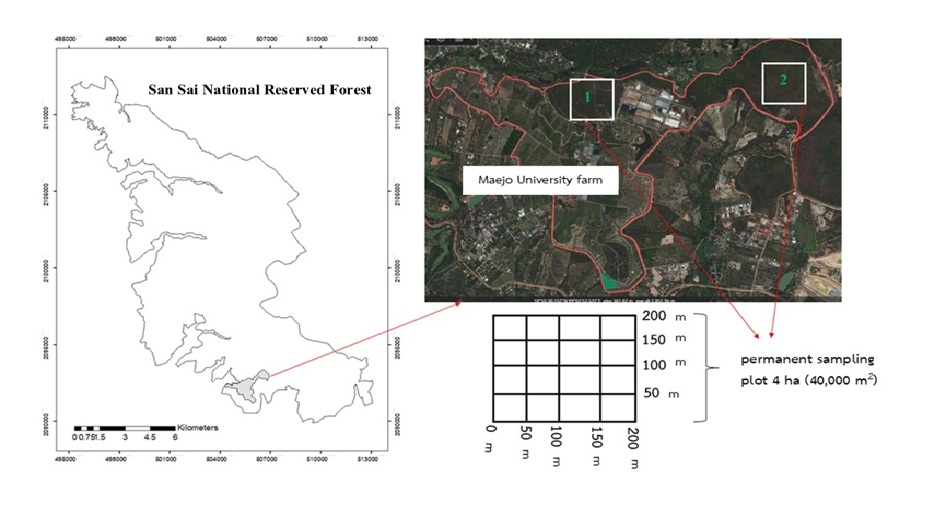
This study quantified forest ecosystem services within the farm area of Maejo University, Chiang Mai with emphasis on supporting and regulating functions. The analysis estimated timber volume and the economic value of carbon storage in forest biomass. Species diversity was assessed, and tree species were determined based on the IUCN Red List. Timber volume and carbon storage in the forest biomass of large trees were quantified within permanent sample plots. Data were obtained from two permanent plots, each covering 4 hectares (25 rai), located within the study area. The forest was classified as a secondary dry dipterocarp forest, comprising 32 species, 28 genera, and 18 families. The dominant species, based on stand structure and the Importance Value Index (IVI), was Dipterocarpus obtusifolius Teijsm. ex Miq. The conservation status assessment identified Least Concern (LC) - 23 species; Near Threatened (NT) - 3 species; Critically Endangered (CR) - 1 species; and Endangered (EN) - 1 species; the other four species were not listed in the IUCN Red List. Regulating services were quantified through carbon storage and sequestration. Forest carbon stock averaged 37.89 t C ha-1, while carbon sequestration was estimated at 19.09 tCO₂eq rai-1. Over a two-year period (baseline year 2025), net carbon sequestration increased by 133.96 tCO₂eq, corresponding to an economic value of 19,476.39 Thai Baht. Provisioning services were represented by timber volume, with an average of 18.46 m³ ha-1 and a total stand volume of 960.09 m3, yielding an estimated economic value of 1,440,139 Thai Baht. The total economic value of ecosystem services (regulating and provisioning) within the University farm area in 2025 was estimated at 1,459,615.39 Thai Baht. These results demonstrate that the secondary forest system contributes to carbon storage and economic valuation within the university-managed landscapes. Management interventions, including forest patrol, stakeholder awareness, and wildfire prevention, are associated with the maintenance of regulating and supporting services, thereby sustaining ecosystem service flows and enhancing long-term natural capital value.
References
Aznar-Sánchez, J.A., L.J. Belmonte-Ureña, M.J. López-Serrano and J.F. Velasco-Muñoz. 2018. Forest ecosystem services: an analysis of worldwide research. Forests 9(8): 453. https://doi.org/10.3390/f9080453
Bolund, P. and S. Hunhammar. 1999. Ecosystem services in urban areas. Ecological Economics 29(2): 293–301.
Carpenter, S.R., E.M. Bennett and G.D. Peterson. 2006. Scenarios for ecosystem services: an overview. Ecology and Society 11(1): 29. https://www.jstor.org/stable/26267787
Chamnongphakdi, K. and N. Udomsiripong. 2015. Value of Carbon Stock in Aboveground Biomass of Deciduous Dipterocarp Forest, Mae Ping National Park at Chiangmai, Lamphun and Tak Provinces. pp. 115–119. In Proceedings of the 5th Thai Forest Ecology Research Network Conference. Bangkok: Department of National Parks, Wildlife and Plant Conservation; National Park and Protected Area Innovation Institute. [in Thai]
Chawhia, W., T. Lattirasuvan, P. Khonkaen and T. Yotapakdee. 2025. Valuation of Doi Luang Chiang Dao, nature trail in Doi Chiang Dao biosphere reserve, Chiang Mai province. Thai Journal of Forestry 44(1): 175–188. [in Thai]
Daily, G.C. 1997. Nature’s Services: Societal Dependence on Natural Ecosystems. Washington, DC.: Island Press. 22 p.
German International Cooperation Agency, the Business Organization for Sustainable Development, and the Thailand Environment Institute Foundation. 2013. Ecosystem values and ecosystem services for business. Retrieved from http://www.tei.or.th/publications/2013-download/2013-TBCSD-giz-valuable-ecosystem-businesses [in Thai]
Hermhuk, S., M. Tasen, P. Ladpala, K. Chowtiwuttakorn and W. Phumphuang. 2025. Factors influencing and patterns of forest utilization in communities around the Huay Tak Teak Biosphere Reserve, Lampang province. Thai Forest Ecological Research Journal 9(1): 19–36. [in Thai]
Hermhuk, S., W. Sungpalee, P. Thongplew and K. Sri-ngernyuang. 2021. Influence of environmental factors on the distribution of tree species in deciduous dipterocarp forest at San Sai Forest Reserve, San Sai district, Chiang Mai province. Thai Forest Ecological Research Journal 5(1): 17–32. [in Thai]
Intergovernmental Panel on Climate Change (IPCC). 2006. IPCC Guidelines for National Biodiversity in Community Forests. Bangkok: Royal Forest Department. 42 p.
Maejo University. 2021. Maejo University Excellence Development Plan 2023-2027: "Towards the Development of Technology and Promotion of Modern Agricultural Innovation". Retrieved from https://www.mju.ac.th/th/ita_document/%202566-2570.pdf [in Thai]
Marod, D. and U. Kutintara. 2009. Forest Ecology. Bangkok: Department of Forest Biology, Faculty of Forestry, Kasetsart University. 540 p. [in Thai]
Millennium Ecosystem Assessment. 2005. Ecosystem and Human Well-being a Framework for Assessment. Washington DC: Island Press. 155 p.
Mooksombat, S. and N.T. Nakhon. 1995. Using the Spiegel Relascope to Construct a Timber Volume Table in the Mae Haeng Sector Demonstration Forest Area, Ngao District, Lampang Province. Bangkok: Forest Management and Demonstration Forest Development Group, Forest Economics and Development Research Division, Forest Research Bureau, Royal Forest Department. 55 p. [in Thai]
Office of Natural Resources and Environmental Policy and Planning. 2019. Handbook on Measurement, Reporting, and Verification (MRV) for Thailand’s Greenhouse Gas Inventory: Forestry and Land Use Sector. Bangkok: Ministry of Natural Resources and Environment. 50 p.
Ogawa, H., K. Yoda, K. Ogino and T. Kira. 1965. Comparative ecological studies on three main types of forest vegetation in Thailand II. Plant biomass. Nature and Life in Southeast Asia 4: 49–80.
Okawa, H.K. and T. Kira. 1977. Methods of estimating forest biomass. pp. 15–36. In Shidei T. and T. Kira (Eds.). Primary Productivity of Japanese Forests; Productivity of Terrestrial Communities Tokyo: University of Tokyo.
Perry, D.A., R. Oren and S.C. Hart. 2008. Forest ecosystems. Baltimore: Johns Hopkins University. 290 p.
Royal Forest Department. 2013. Data from Timber Price Surveys, Compiled by the Private Sector Reforestation Division, Forest Plantation Promotion Bureau. Bangkok: Royal Forest Department. 20 p. [in Thai]
Shannon, C.E. and W. Weaver. 1949. A mathematical theory of communication. The Bell System Technical Journal 27(3): 379–423.
Sri-Ngernyuang, K., P. Bangthit, V. Daengbut, T. Tanruangporn, T. Suntreesilpaphon, W. Sungpalee and S. Hermhuk. 2023. A Land Use Study to Support Information for the Application to Use Land in the San Sai National Forest Reserve, Chiang Mai Province. pp. 245-254. In The 12th Thailand Forest Ecology Research Network Conference, February 9-10. Chiang Mai: Faculty of Agriculture Chiang Mai University. [in Thai]
Sukamolson, S. 2017. Priori and posteriori comparisons for a research study. Academic Journal of Buriram Rajabhat University 9(2): 51–70. [in Thai]
Suwankesa, S., S. Hermhuk, W. Sungpalee, K. Sri-Ngernyuang and K. Satienperakul. 2023. Effects of forest restoration on forest utilization of Ban Huai Pu Ling Forest Development Station, Om-Koi district, Chiang Mai province. Thai Forest Ecological Research Journal 7(2): 141–158.
Tamniyom, S., S. Hermhuk, T. Kamyo, Y. Ponpituk and W. Panya. 2026. The forest dynamics of carbon sequestration and some environmental factors influencing the distribution of tree species in the Royal-Instated Mae-Aow River Basin Development Project, Lamphun province. KKU Science Journal 54(1): 192–206.
Thailand Greenhouse Gas Management Organization (Public Organization). 2022. Carbon credit information. Retrieved from https://www.tgo.or.th/2023/index.php/th/ [in Thai]
Vongsenekeo, M., S. Hermhuk, W. Sungpalee, K. Sri-ngernyuang and K. Satienpirakul. 2022. Assessment of habitat suitability of Melientha suavis Pierre (Opiliaceae) based on some environmental factors in Ban Pong Development Project Area of Royal Initiative Project, San Sai district, Chiang Mai province. Journal of Research, Rajamangala University of Technology Srivichai 14(2): 513–528. [in Thai]
Wansa, N. 2022. Utilization of fuelwood guidelines for sustainable forest management in the Royal Initiative Project Huai Mae Kieng Highland Agricultural Development Station, Chiang Dao District, Chiang Mai Province. Master Thesis. Maejo University. 169 p. [in Thai]
Wattanasukskul, S., S. Khamyong, K. Sri-Ngenyuang and N. Anongrak. 2012. Plant species diversity and carbon stocks in dry dipterocarp forest with and without fire at Intakin Silvicultural Research Station, Chiang Mai province Journal of Forestry 31(3): 1–14. [in Thai]
Yarnvudhi, A., N. Leksungnoen, P. Tor-Ngern, A. Premashthira, S. Thinkampheang and S. Hermhuk. 2021. Evaluation of regulating and provisioning services provided by a park designed to be resilient to climate change in Bangkok, Thailand. Sustainability 13(24): 13624. https://doi.org/13610.13390/su132413624.
Downloads
Published
How to Cite
Issue
Section
License
Copyright (c) 2026 Journal of Agricultural Research and Extension

This work is licensed under a Creative Commons Attribution-NonCommercial-NoDerivatives 4.0 International License.
This article is published under a Creative Commons Attribution-NonCommercial-NoDerivatives 4.0 International License (CC BY-NC-ND 4.0), which allows others to share the article with proper attribution to the authors and prohibits commercial use or modification. For any other reuse or republication, permission from the journal and the authors is required.