
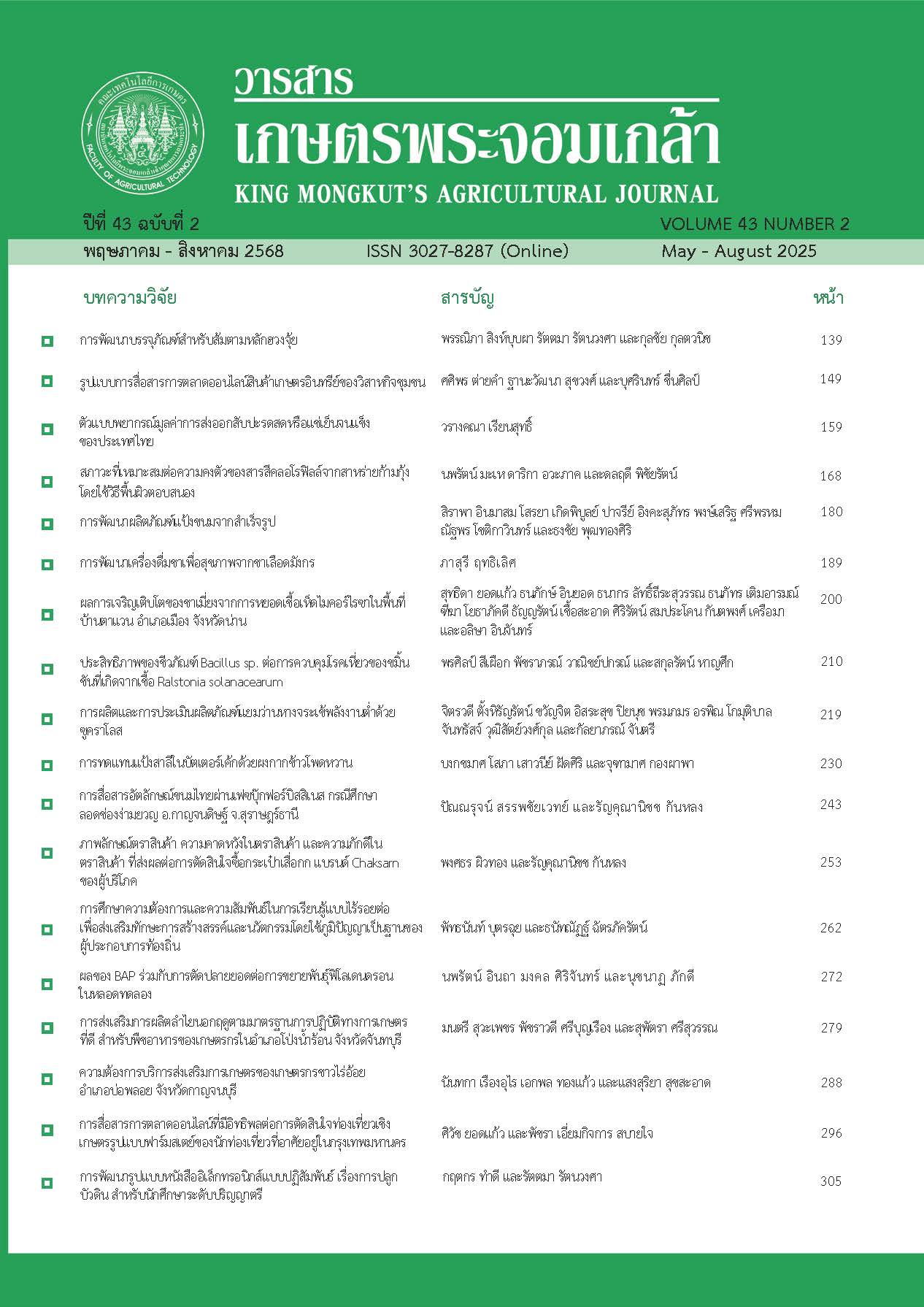
รูปแบบการสื่อสารการตลาดออนไลน์สินค้าเกษตรอินทรีย์ของวิสาหกิจชุมชน
Article Sidebar
Main Article Content
บทคัดย่อ
การจำหน่ายผลิตภัณฑ์ออนไลน์เป็นที่นิยมในปัจจุบัน แต่วิสาหกิจชุมชนภาคเกษตรส่วนใหญ่ไม่ค่อยจำหน่ายผลิตภัณฑ์ออนไลน์ จึงต้องศึกษาและพัฒนารูปแบบด้วยการวิจัยและพัฒนา โดยมีวัตถุประสงค์เพื่อ (1) ศึกษาข้อมูลพื้นฐานในการพัฒนารูปแบบการสื่อสารการตลาดออนไลน์สินค้าเกษตรอินทรีย์ของวิสาหกิจชุมชน โดยการสัมภาษณ์ผู้ให้ข้อมูลหลัก 20 คน และสำรวจความไว้วางใจของผู้บริโภค 343 คน (2) พัฒนารูปแบบการสื่อสารการตลาดออนไลน์สินค้าเกษตรอินทรีย์ของวิสาหกิจชุมชน และ (3) ทดลองและปรับปรุงรูปแบบการสื่อสารการตลาดออนไลน์สินค้าเกษตรอินทรีย์ของวิสาหกิจชุมชน ผลศึกษาข้อมูลพื้นฐาน พบว่า วิสาหกิจชุมชนบางส่วนขาดความรู้ด้านการสื่อสารการตลาดออนไลน์ ผู้บริโภคให้ความสำคัญต่อปัจจัยการสื่อสารการตลาดออนไลน์มาก (mean = 4.20, SD = 0.70) ผลการวิเคราะห์การถดถอยเชิงเส้นแบบง่าย พบว่า ปัจจัยด้านเนื้อหา (𝛃 = 0.53, t = 4.70, p-value = .00) และด้านช่องทางสื่อสาร (𝛃 = 0.31, t = 3.87, p-value = .00) มีผลต่อความไว้วางใจของผู้บริโภคด้านการสื่อสารการตลาดออนไลน์อย่างมีนัยสำคัญทางสถิติที่ .05 จากนั้นนำข้อมูลมาพัฒนารูปแบบการสื่อสารการตลาดออนไลน์สินค้าเกษตรอินทรีย์ของวิสาหกิจชุมชน ประกอบด้วย (1) เกษตรกรมีความรู้ด้านการสื่อสารการตลาดออนไลน์ ผลิตสินค้าได้มาตรฐานอินทรีย์ ซื่อสัตย์ ร่วมกันสร้างเครือข่ายขายสินค้าออนไลน์ (2) เนื้อหาเกี่ยวข้องกับผลิตภัณฑ์และผู้บริโภค มีประโยชน์ น่าสนใจ ประเด็นชัดเจน น่าเชื่อถือ ดึงดูดด้วยการเล่าเรื่อง ปรับปรุงสม่ำเสมอ (3) ช่องทางสื่อสารออนไลน์ใช้งานง่าย สะดวก ค่าใช้จ่ายน้อย (4) กระบวนการพาณิชย์อิเล็กทรอนิกส์ครบถ้วน (5) ผู้บริโภคตระหนักและมีความรู้เกี่ยวกับความปลอดภัยของอาหาร และมาตรฐานเกษตรอินทรีย์ และ (6) ปฏิกิริยาตอบกลับ รูปแบบผ่านการประเมินจากผู้เชี่ยวชาญมีความเหมาะสมและปฏิบัติได้จริง และกลุ่มทดลองมีความพึงพอใจต่อรูปแบบ
Article Details

อนุญาตภายใต้เงื่อนไข Creative Commons Attribution-NonCommercial-NoDerivatives 4.0 International License.
วารสารเกษตรพระจอมเกล้า
เอกสารอ้างอิง
Chatzoglou, P., & Chatzoudes, D. (2016). Factors affecting e-business adoption in SMEs: an empirical research. Journal of Enterprise Information Management, 29(3), 327-358.
Community Enterprise Promotion Division. (2023). Summary of the Number of Community Enterprises and Community Enterprise Networks Approved for Registration. Community Enterprise Promotion Division. (in Thai).
Gallego, M. D., Bueno, S., & López-Jiménez, D. (2016). Impact of B2C e-commerce codes of conduct on sales volume: lessons from the Spanish perspective. Journal of Business & Industrial Marketing, 31(3), 381–392.
Hanna, N. K. (2016). E-commerce as a techno-managerial innovation ecosystem: Policy implications. Journal of Innovation Management, 4(1), 4-10.
Jambulingamis, M., Sumathi, C., & Rajagopal, G. (2015). Barriers of Venturing into Facebook Commerce among SMEs. Journal of Internet Banking and Commerce, 21(Suppl.2), 1-9.
Kanchanopast, S. (2011). The Factors Influencing Successful Implementation of E Commerce to Create Competitive Advantage, within SME Businesses. Suan Sunandha Rajabhat University. (in Thai).
Kasikorn Research Center. (2018). Organic Market: Thai SME Money Generating Business. Kasikorn Research Center. (in Thai).
Kull, K. (2007). The Model of Internet-Based Marketing Communication, Mattimar. Retrieved from: https://www.semanticscholar.org/paper/THE-MODEL-OF-INTERNET-BASED-MARKETING-COMMUNICATION-Kull/3e92ebe4a76db2af27b345137867e1e6c286e325.
Ministry of Agriculture and Cooperatives. (2022). Agriculture and Cooperatives Action Plan 2023-2027. Retrieved from: https://www.opsmoac.go.th/phichit-dwl-files-442991791932. (in Thai).
Nastasi, B. K., & Schensul, S. L. (2005). Contributions of qualitative research to the validity of intervention research. Journal of School Psychology, 43(3), 177-195.
National Statistical Office. (2016). Report of the Labor Force Survey Whole Kingdom. Retrieved from: http://service.nso.go.th/nso/nsopublish/themes/files/lfs59/reportJun.pdf. (in Thai).
Office of the National Economic and Social Development Council. (2022). The thirteenth national economic and social development plan (2023-2027). Thai Government Gazette, 139(258), 6-9. (in Thai).
Panyakul, W. (2016). Overview of Thai Organic Agriculture 2015: Sai Jai Phaendin Foundation. Retrieved from: http://www.greennet.or.th/sites/default/files/Thai%20OA%2015.pdf. (in Thai).
Ramayah, T., Ling, N. S., Taghizadeh, S. K., & Rahman, A. (2016). Factors influencing SMEs website continuance intention in Malaysia. Telematics and Informatics, 33(1), 150–164.
Theeranithiwat, K. (2016). Online Vs Offline marketing. Retrieved from: http://www.ifarm.in.th/index.php?option=com_content&view=article&id=736:online-vs-offline-marketing. (in Thai).
Vongsraluang, N., & Bhatiasevi, V. (2016). The Determinants of Social Commerce System Success for SMEs in Thailand. Mahidol University International College. (in Thai).
Wanga, W. T., Wanga Y. S., & Liuc, E. R. (2016). The stickiness intention of group-buying websites: The integration of the commitment–trust theory and e-commerce success model. Information & Management, 53(5), 625-642.
Yang, T. A., Kim, D. J., Dhalwani, V., & Vu, T. K. (2008). The 8C framwork as a reference model for collaborative value webs in the context of web 2.0. In Proceedings of the 41st Hawaii International Conference on System Sciences – 2008, pp. 1-10. University of Hawaii at Manoa.
Yenyodwichai, P. (2015). Social Media and Agricultural Product Marketing Channel, Technology Chao Ban. Retrieved from: http://www.technologychaoban.com/news_detail.php?tnid=1746. (in Thai).
Young, L. (2011). The Marketer’s Handbook: Reassessing Marketing Techniques for Modern Business. John Wiley & Sons.
