
A Study of Correlation between Time with Persistence and Quality of Latent Fingerprint on Non-porous Materials in Different Environments
Article Sidebar
Main Article Content
Abstract
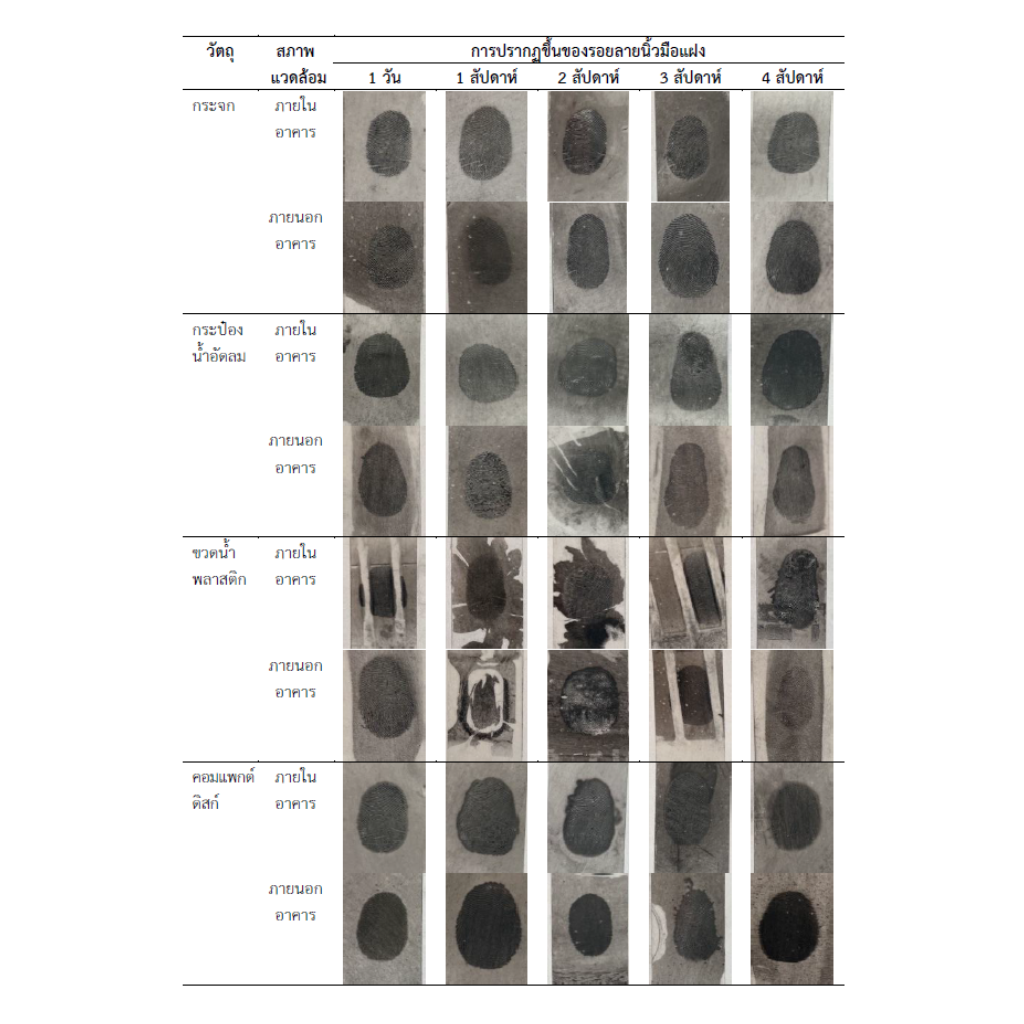
This research aimed to study the relationship between a period time with the persistence factors and quality of latent fingerprints on non-porous surfaces in different environments which was an experimental study. The study was conducted to determine the persistence of latent fingerprints on the surfaces of 7 types of substrates: glass, mirror, soft drinks cans, plastic bottles, compact discs, doorknobs, and knives, as well as to compare the quality of latent fingerprints collected in indoor and outdoor environments. The experimental periods for collecting latent fingerprints were 1 day, 1, 2, 3, and 4 weeks. Using the black powder method to collect latent fingerprints and scoring them by counting special characteristics by experts. The results of the research found that the latent fingerprint imprinted on the sample object will have a decrease in the persistence of the latent fingerprint over time. The latent fingerprint stored in an indoor environment has a lower decrease in the persistence rate than the latent fingerprint stored in an outdoor environment. The collection of latent fingerprints from indoor environments will provide better quality of latent fingerprints than the collection of latent fingerprints from outdoor environments. The mirror can detect the best quality of latent fingerprints in both indoor and outdoor environments. The quality of the latent fingerprints is not different after leaving the imprint for 4 weeks. While the soft drink cans have low quality latent fingerprints in both environments. The preliminary results show that the environment and the type of object affect the duration of the latent fingerprints, but the duration is not clearly different.
Article Details

This work is licensed under a Creative Commons Attribution-NonCommercial-NoDerivatives 4.0 International License.
Authors retain the copyright of articles published in Wichcha Journal Nakhon Si Thammarat Rajabhat University. All published articles are distributed under the Creative Commons Attribution–NonCommercial–NoDerivatives License (CC BY-NC-ND 4.0) (https://creativecommons.org/licenses/by-nc-nd/4.0/). Under this license, readers are permitted to read, download, and share the articles for non-commercial purposes, provided that proper attribution to the original source is given and the content is not modified or altered. All contents of the articles, including text, tables, figures, equations, and other illustrations, are the sole responsibility of the authors. The views and opinions expressed in the articles do not necessarily reflect those of the editorial board or the publisher.
References
ณัฏฐิรา สงฆ์โนนเหล็ก. (2555). การทำให้ปรากฎขึ้นของรอยลายนิ้วมือแฝงบนพื้นผิวไม่มีรูพรุนโดยใช้ผงขมิ้น. วิทยานิพนธ์วิทยาศาสตรมหาบัณฑิต (นิติวิทยาศาสตร์). มหาวิทยาลัยศิลปากร, นครปฐม.
ศิริรัตน์ เที่ยงเธียรธรรม. (2556). การปรากฎขึ้นของลายนิ้วมือแฝงบนวัตถุที่จมอยู่ในน้ำธรรมชาติโดยใช้ small particle reagent และผงฝุ่นดำ. วิทยานิพนธ์วิทยาศาสตรมหาบัณฑิต (นิติวิทยาศาสตร์). มหาวิทยาลัยศิลปากร, นครปฐม.
Bleay, S.M., Croxton, R.S. and De Puit, M. (2018). Fingerprint development techniques: Theory and application. West Sussex: Wiley.
De Alcaraz-Fossoul, J., Mestres Patris, C., Balaciart Muntaner, A., Barrot Feixat, C. and Gené Badia, M. (2013). Determination of latent fingerprint degradation patterns-A real fieldwork study. International Journal of Legal Medicine, 127, 857-870, doi: https://doi.org/10.1007/s00414-012-0797-0.
Gray, T. (2012). Impact of time, weathering and surface type on fingerprinting. Proceedings of The National Conference on Undergraduate Research (pp. 1588-1596). Utah: Weber State University.
Johnston, A. and Rogers, K. (2017). The effect of moderate temperatures on latent fingerprint chemistry. Applied Spectroscopy, 71(9), 2102-2110, doi: https://doi.org/10.1177/0003702817694902.
Kücken, M. and Newell, A.C. (2005). Fingerprint formation. Journal of Theoretical Biology, 235(1), 71-83, doi: https://doi.org/10.1016/j.jtbi.2004.12.020.
